
Beyond Solar Inspection: One DJI Dock 3, Three Operational Missions in Saudi Arabia

A real-world deployment by Glider Aerial Solutions at a large-scale solar energy site in Al Majma’ah, Saudi Arabia.
Project and client identity are confidential.
Introduction
Solar facilities are designed to operate at scale. Their arrays extend across large areas, their assets are distributed, and their teams must often make decisions from locations far from the point of activity. That creates an operational challenge that is broader than inspection alone: how can one aerial system help teams inspect equipment, understand what is happening across the site, and communicate when needed?
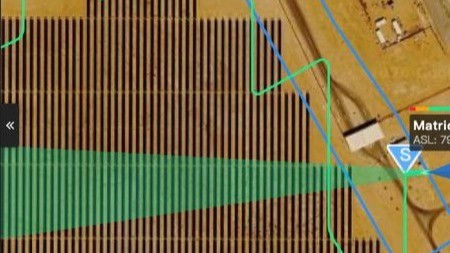
Glider Aerial Solutions recently deployed DJI Dock 3 with DJI Matrice 4TD at a large-scale solar energy site in Al Majma’ah, Saudi Arabia. The deployment was managed through DJI FlightHub 2 and explored how a remotely operated drone-in-a-box workflow could serve three distinct operational use cases:
• Thermal solar inspection
• Aerial site monitoring and security awareness
• Remote communication using the DJI AS1 Speaker
This was a real local deployment, not a laboratory exercise. At the same time, the project name and client identity remain confidential. We are therefore sharing the operational approach and lessons learned without disclosing sensitive site information or presenting unverified performance figures.
The Challenge: More Than a Solar Inspection Task
At a large solar site, traditional inspection methods can require teams to move across long distances to reach different sections of the array. This can make repeatable coverage, consistent documentation and rapid follow-up more demanding. Meanwhile, operations and security personnel need awareness beyond the immediate area around them.
The challenge is not simply to fly a drone over panels. It is to create a practical workflow that can be planned, observed and repeated—while supporting different site teams from the same infrastructure.
For this deployment, Glider assessed the DJI Dock 3, Matrice 4TD and FlightHub 2 combination as an integrated operational system. The Dock 3 provided the remotely operated base; the Matrice 4TD collected visual and thermal information; and FlightHub 2 provided a centralized environment for mission planning and live operational visibility.
Mission 1: Thermal Solar Inspection
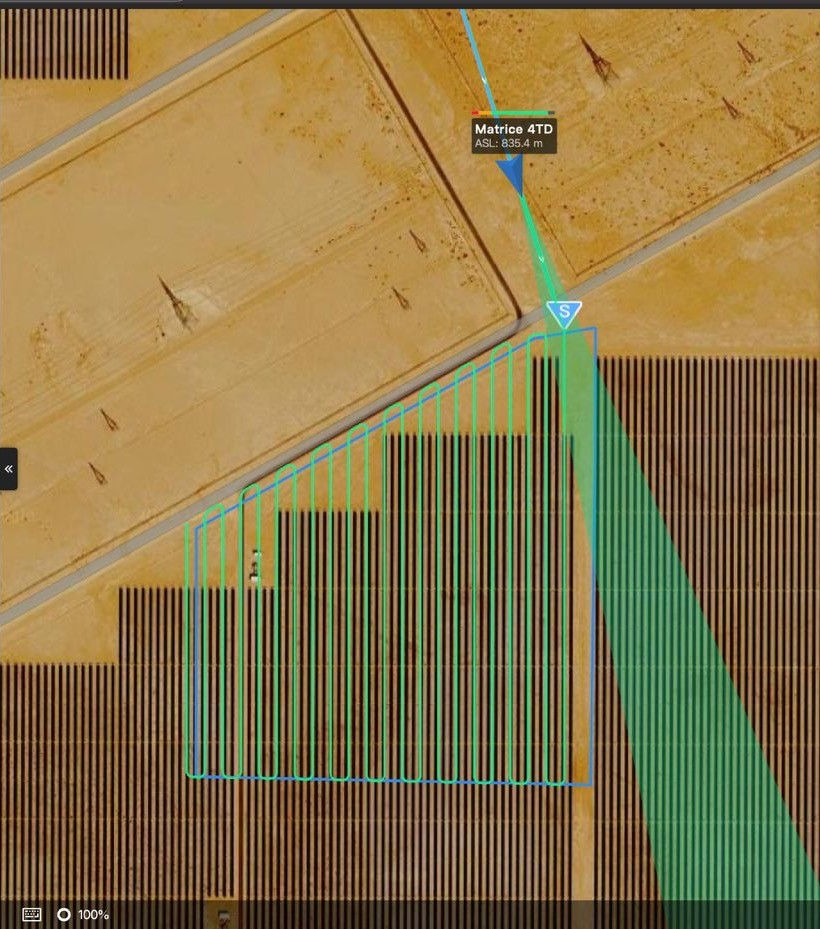
The first use case was thermal inspection of solar-panel arrays. Flight routes were planned across defined sections of the site so that the aircraft could collect repeatable visual and thermal data from above.
Thermal imagery is valuable because it can reveal temperature differences that may not be apparent in standard visual imagery. In this context, the purpose is not to claim that a thermal image directly measures the efficiency of an individual panel. It is to identify thermal anomalies and areas that may require closer engineering review, maintenance assessment or comparison with other available site data.
That distinction matters. A temperature difference is an indicator, not a final diagnosis. Its operational value comes from guiding the technical team toward locations that deserve further investigation.
The deployment demonstrated a structured path from mission planning to data collection. Planned routes helped create a consistent inspection pattern across the arrays, while visual and thermal information created a richer basis for a follow-up assessment. This can support a repeatable workflow for future monitoring where the site’s own maintenance process determines how findings are reviewed and acted upon.
Mission 2: Aerial Site Monitoring and Security Awareness
A solar facility is both an energy asset and a large physical environment. Beyond the equipment itself, operations teams need situational awareness across areas that can be difficult to observe continuously from the ground.
The same aerial infrastructure used for inspection was also evaluated as an additional layer of site monitoring. Scheduled or on-demand missions can provide an elevated view of parts of the facility and help teams observe unexpected activity, assess an area before dispatching personnel, or establish a clearer operational picture during the working day.
This is not a replacement for the site security team or for established security procedures. It is an additional source of aerial awareness that can complement people, processes and on-site systems. The value is particularly clear on large sites, where travelling to investigate an event can take time and the first question is often simply: what is happening there now?
With FlightHub 2, operators can work from a centralized mission-control environment rather than treating every flight as an isolated task. That helps bring inspection and operational monitoring into the same digital workflow, even when the mission objectives are different.
Mission 3: Remote Communication with the DJI AS1 Speaker
The third use case added a different dimension: communication. The DJI AS1 Speaker allows an operator to broadcast audio from the aircraft, making it possible not only to see an area from above but also to communicate with people on the ground.
For a large solar site, this creates several practical possibilities. An operator may use the aircraft to provide operational instructions, alert personnel in a designated area, or direct someone toward a particular route or control point. It can also support a guidance scenario in which a person operating far from familiar landmarks needs clear instructions to reach a designated location or exit route.
One Infrastructure, Multiple Workflows
The key lesson from this project is that DJI Dock 3 should not be understood only as a charging station. Combined with Matrice 4TD and FlightHub 2, it can become part of an operating model for large sites.
For inspection, the workflow is planned route → visual and thermal data → technical assessment.
For monitoring, it is scheduled or on-demand mission → aerial visibility → operational awareness.
For communication, it is aerial positioning → AS1 Speaker broadcast → direction or instruction for personnel on the ground.
What We Learned
First, the value lies in the workflow, not only the aircraft. A thermal camera is useful, but its practical contribution grows when routes can be planned, missions remotely observed and data brought into a structured review process.
Second, one platform can support different teams. Inspection, operations and security personnel have different questions, yet they may benefit from a common source of aerial information.
Third, remote operations become more relevant as the site becomes larger. The greater the distance between operational areas, the more useful it can be to access information without requiring people to physically travel to every point before they can make an informed decision.
Looking Beyond Solar
Solar energy is a strong example of this operating model, but the approach is not limited to solar. Large industrial facilities, utilities, infrastructure projects, construction environments and remote assets can face similar challenges: repeatable inspection, distributed operations, and the need for timely awareness over a wide area.
Conclusion
The DJI Dock 3 and Matrice 4TD deployment at a solar energy site in Al Majma’ah showed how one drone infrastructure can support more than one mission. From thermal inspection of solar arrays, to aerial site monitoring, to remote communication through the AS1 Speaker, the project explored the potential of integrating hardware, remote operations and centralized mission management in one workflow.
At Glider Aerial Solutions, we continue to turn DJI Enterprise technologies into practical workflows for the Saudi market—bringing together hardware, operations, training, maintenance and data as one integrated ecosystem.
Comments